Exceptional dining experiences straight to your doorstep
When you freeze-dry food, you’re not just pulling out water; you’re also changing how its nutrients behave. You’ll often keep most vitamins, minerals, and proteins, but some sensitive nutrients, like vitamin C, don’t fare quite as well. The result can be both more nutrient-dense by weight, yet not always equal to fresh. Whether that trade-off matters for your health depends on a few key details you might not expect.
So, is freeze dried vegetables healthy as a diet practice? In most cases, freeze-drying preserves a high proportion of a food’s original nutrients, typically retaining about 90–97% of vitamins, minerals, proteins, and many antioxidants compared with fresh forms.
Water-soluble vitamins such as vitamin C and certain B vitamins often decline by around 5–10%. Proteins are largely unaffected, with studies indicating about 95–100% retention, and minerals generally remain at approximately 98–100%. When compared with methods like hot air or spray drying, which can reduce some sensitive vitamins by 40–70%, freeze-drying tends to maintain substantially more nutritional value.
With airtight, cool, low-moisture, and dark storage conditions, this nutrient retention can remain relatively stable for extended periods.
Freeze-drying is more than simple dehydration; it alters food structure through a controlled, two-step process. First, the food is frozen solid. It's then placed under a deep vacuum so that the ice undergoes sublimation, changing directly from solid to vapor without passing through the liquid phase.
During sublimation, the temperature remains very low, often below −40°C, which helps preserve the physical structure of the food. As ice crystals leave, they form microscopic channels within cells, resulting in a light, porous texture. These pores reduce the collapse of the food matrix and help retain proteins and minerals. Limited exposure to liquid water and reduced oxygen contact slow oxidation, which can help maintain certain vitamins, antioxidants, and other sensitive compounds more effectively than many conventional drying methods.
Understanding how freeze-drying removes water at low temperatures helps clarify why many nutrients are largely preserved. The process primarily affects moisture content and texture, while most of the chemical structure of nutrients remains stable.
Proteins are generally well retained, with reported values around 95–100%. While the texture of the food may change, the amino acid profile is largely conserved. Minerals such as iron, calcium, potassium, and magnesium are also very stable during freeze-drying, with retention typically close to 98–100%, since they aren't easily destroyed by temperature or oxidation under these conditions.
Fat-soluble vitamins (A, D, E, and K) tend to be relatively stable, especially when protected from light and oxygen, although exact retention can vary with food type and storage conditions. Many B vitamins show high retention, often in the range of about 90–97%, provided the process and subsequent storage minimize exposure to heat, light, and air. Vitamin C, which is more sensitive to oxidation and heat, is better preserved in freeze-dried foods than in many other drying methods, with reported retention commonly in the 90–97% range, assuming appropriate handling and storage.
Even with freeze-drying’s low temperatures and reduced oxygen exposure, some nutrients are still more vulnerable than others. Vitamin C shows the most notable loss, with typical reductions of about 5–10%, mainly due to gradual oxidation over the longer drying times.
Certain B vitamins, especially the more heat- and light-sensitive ones, can also decline, but they're generally well preserved, with retention commonly around 90–95%, which is higher than in conventional hot-air drying. Some polyphenols and pigment-associated antioxidants may also decrease slightly during extended processing. However, these changes are usually moderate, and overall antioxidant capacity often remains relatively high compared with other drying methods.
While freeze-drying is one of the gentlest methods of food preservation, some nutrient loss still occurs due to several factors. A primary cause is oxidation: during loading, processing, and unloading, foods are exposed to small amounts of oxygen. This gradual exposure can degrade oxygen-sensitive nutrients such as vitamin C, often leading to modest losses in the range of about 5–10%, depending on the food and conditions.
The extended processing time at low temperatures (typically 16–48 hours) can also contribute to the degradation of certain compounds, including some antioxidants and polyphenols. If enzymes remain active before the product is fully frozen, they can continue to break down sensitive vitamins and other labile components.
In the secondary drying phase, when remaining bound water is removed, increased exposure of cellular structures can further affect nutrients. This phase can destabilize vitamin C and some B vitamins, particularly if microstructural damage increases contact with residual oxygen, leading to additional oxidative losses.
Compared with other drying methods, freeze-drying generally preserves a higher proportion of nutrients. Studies show that freeze-dried foods often retain about 90–97% of vitamins, proteins, minerals, and many antioxidants.
In contrast, hot-air drying can reduce heat‑sensitive nutrients, such as vitamin C and several B vitamins, by roughly 40–60% or more, depending on temperature, time, and the specific food. Drying at 50–70°C in particular is associated with substantial losses of these vitamins, which can lower the nutritional value of the final product.
Minerals such as iron, calcium, and potassium are comparatively stable during freeze-drying, with reported retention rates close to 98–100%. Protein content and quality are also largely maintained, typically in the range of 95–100%.
These outcomes are generally more favorable than those seen with higher-temperature thermal drying methods, which tend to accelerate nutrient degradation through heat and oxidation.
Although all three methods remove water, freeze-drying, spray drying, and microwave vacuum drying differ in how they affect nutrients.
Freeze-drying removes ice by sublimation at very low temperatures and low pressure. Because the product isn't exposed to high heat, it generally preserves a high proportion of vitamins (often around 90–97%, depending on the vitamin and food matrix) and most minerals, which are relatively heat-stable.
Spray drying exposes liquids or slurries to hot air, typically around 150–200°C, for a short time. This elevated temperature can significantly reduce heat-sensitive vitamins, such as vitamin C and some B vitamins, with reported losses that can exceed 70% in certain products and conditions. More stable nutrients, including many minerals, are less affected.
Microwave vacuum drying operates at reduced pressure and moderate temperatures (about 30–50°C). Under these conditions, nutrient retention is often comparable to that of freeze-drying, particularly for heat-sensitive compounds, while drying times can be substantially shorter, on the order of tens of times faster in some studies. The combination of reduced processing time and lower energy demand can translate into lower operating costs compared with conventional freeze-drying, though exact savings depend on scale, equipment design, and product type.
Freeze-dried foods differ in texture and appearance from fresh or frozen options, but their nutritional content is generally comparable. In many cases, they retain approximately 90–97% of the original vitamins, minerals, and antioxidants.
Protein and mineral content are largely preserved, with protein quality typically remaining around 95–100% and minerals around 98–100%. Water-soluble vitamins, such as vitamin C and several B vitamins, are more sensitive to processing and storage, so their levels may decrease slightly more, often by about 5–10%.
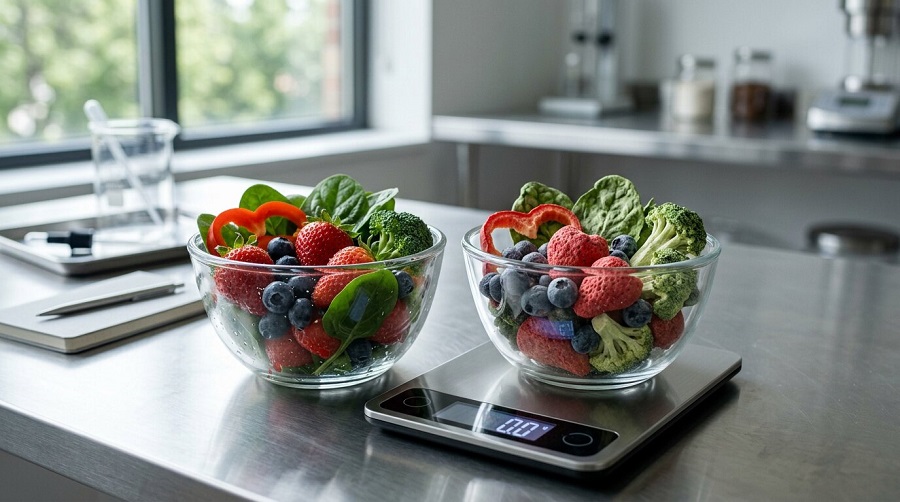
Because most of the water is removed during freeze-drying, the remaining product is more concentrated. As a result, each gram of freeze-dried food contains more nutrients and calories than the same weight of the fresh version, even though the total nutrients per serving (when rehydrated) are similar.
When stored correctly, freeze‑dried foods can maintain most of their original nutritional value for several years.
Effective storage requires airtight, moisture‑proof packaging, such as mylar bags with oxygen absorbers or properly vacuum‑sealed jars, to keep residual moisture very low (around 2%). This helps prevent gradual, unintended rehydration, which can degrade heat‑ and oxygen‑sensitive nutrients over time.
Storage conditions should be cool, dry, and dark, ideally below about 20°C. Elevated temperatures and exposure to light accelerate the loss of vitamin C and other sensitive compounds, such as certain polyphenols. Limiting oxygen exposure by using oxygen absorbers or inert‑gas flushing (for example, nitrogen) further slows oxidative damage to vitamins, fats, and antioxidants.
After a package is opened, it's important to minimize contact with air and humidity. Reseal promptly or transfer the contents to airtight containers, optionally with desiccants or new oxygen absorbers.
Under appropriate storage conditions, freeze‑dried foods can retain a high proportion of their nutrients, often reported as 90–97% of their pre‑drying levels. However, actual retention varies by food type, specific nutrient, and storage duration.
When you choose freeze-dried foods, you’re keeping most of the nutrition you’d get from fresh or frozen, especially proteins, minerals, and many antioxidants. A few fragile vitamins drop a bit, but not dramatically. The real key is how you store them: airtight, cool, dark, and dry. Do that, and you’ll get long-lasting convenience with surprisingly little nutrient trade-off, making freeze-dried options a smart part of your food plan.